
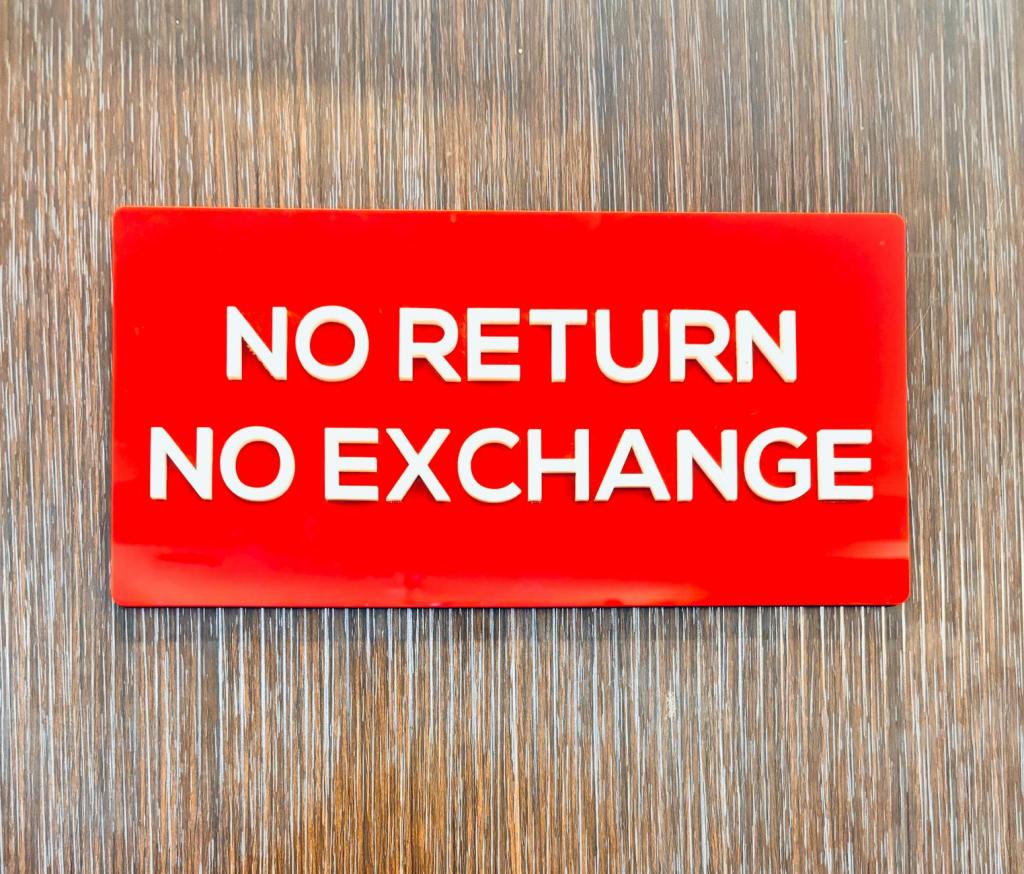
“No refunds.” It’s one of the most common signs in Australian retail — and one of the most misleading. You’ll find it printed on receipts, taped beside cash registers, and in the fine print of online checkouts. Despite how definitive it sounds, Australian law gives shoppers a set of guarantees that no shopfront notice, no website disclaimer, and no carefully worded terms and conditions can sign away.
That gap between what retailers imply and what the law actually requires is where most consumers get caught out. People assume they have no recourse or accept a store credit they didn’t want, simply because a sign told them so. In reality, the protections that apply whenever you buy something from a store in Australia are far broader than most shoppers realise — and far harder for a business to escape than a printed disclaimer suggests.
But what do those protections actually mean when a purchase turns out to be faulty? Do they cover every type of problem, or only certain defects? And do the same rules still apply if you bought the item second-hand, or off a stranger on an online marketplace?
A “no refunds” sign doesn’t mean no rights
Under the Australian Consumer Law (ACL), businesses cannot opt out of the fundamental consumer protections contained within the ACL itself. That means a store policy saying “no refunds” cannot override your legal rights if a product has a problem, no matter how prominently a sign is displayed, how firmly a shop assistant insists otherwise, or how many capital letters are used.
Almost every time you buy goods from a business in Australia, those goods come with a set of automatic consumer guarantees — protections that attach to the transaction itself and which cannot be diminished by a retailer. One of the most important protections is the ‘guarantee as to acceptable quality’ in s 54 of the ACL. This guarantee requires goods to be safe, durable, free from defects, fit for the purposes they are commonly bought for, and acceptable in appearance and finish — standards that are judged by what a reasonable consumer would expect, given the nature of the product, the price paid, and any claims made by the manufacturer or retailer.
If a product fails to meet that standard, the ACL steps in regardless of what the store’s policy claims — the customer’s entitlement to a remedy flows from the law, not from the generosity of the store. A retailer is free to be generous beyond the ACL’s minimum protections (eg, many stores also offer change-of-mind returns within a certain period, even though the law does not require it), but what they cannot do is contract their way below the statutory protections.
In fact, a blanket “no refunds” sign can itself fall foul of the ACL. A simple sign set out in those terms can give the impression that customers have no right to a remedy when the product is faulty — even when the law plainly says they do. As such, displaying these signs can be regarded as misleading or deceptive conduct, as they mislead the consumer about their rights and the store’s responsibilities.
But when are you actually entitled to a refund?
If there has been a breach of a consumer guarantee, the remedy available to the customer depends on how serious the problem is. The ACL draws a line between ‘major’ and ‘minor’ failures, and that line determines who gets to choose which remedy is provided.
The main test for when a defect is a ‘major failure’ is if the product wouldn’t have been purchased by a reasonable consumer who knew all about the defect. Where the failure is major, the choice of remedy belongs to the consumer — they can typically choose a refund, replacement (if a replacement is available), or repair (if repair is possible). In this situation, the consumer can insist on a refund regardless of what the retailer would prefer, and no matter what their store policy states.
A ‘minor failure’ is a different matter. A defect is classed as a minor failure if it doesn’t satisfy the test for a major failure, as set out above. Where the failure is minor and capable of being made right within a reasonable time, the business gets to choose the remedy. The store may opt to repair the item, replace it, or refund it — the consumer can’t insist on the remedy of their choice.
Does it matter if the product is second-hand?
Many people assume that second-hand goods aren’t covered by the same consumer guarantees as new goods, but in reality, the good being second-hand doesn’t matter as you may think. The ACL still applies to second-hand goods, provided they are sold in the course of trade or commerce (so, eg, if a product is sold by a business the ACL will still apply, but the ACL is less likely to apply if you buy a product from a random person who is clearing out their garage and selling their unwanted junk on Facebook Marketplace). So the consumer guarantee as to acceptable quality still attaches to a used phone bought from a refurbishing business or a vintage jacket purchased from a vintage boutique, for example.
The label “second-hand” does not strip the buyer of their statutory protections. What changes is the standard against which the goods are measured. Remember that the guarantee as to acceptable quality is determined by what a reasonable consumer would expect. A reasonable consumer would not expect a second-hand product to be flawless. The age of the item, the price paid, the way it was described, and any visible issues all feed into the assessment of what “acceptable quality” actually means in the circumstances. Further, the ACL sets out that goods “do not fail to be of acceptable quality” if the consumer examines the goods before buying them and that examination “ought reasonably to have revealed that the goods were not of acceptable quality.”
A small stain on a fifty-year-old jacket is unlikely to amount to a breach (especially if you had a chance to look at the jacket and you should have noticed the stain yourself), but a hidden mechanical defect that renders a used appliance unusable almost certainly will be a breach.
So your consumer rights still apply to second-hand purchases from businesses — they are simply calibrated to what a reasonable consumer would expect from that kind of second-hand item, at that price, in that condition, and considering what you should have noticed before buying the good.
Conclusion
The phrase “no refunds” sounds absolute, but in practice it is heavily qualified by the law that sits behind almost every Australian retail transaction — the ACL. If you buy from a business and the product is faulty, your rights under the ACL will override any store policy that tries to restrict your rights. Any sign or notice that suggests otherwise is misleading or deceptive.
If you buy second-hand from a business, those rights still apply — they are simply measured against more modest expectations. But if you buy from a private seller (eg, on an online marketplace) who is not conducting a business, the statutory protections probably don’t apply, meaning you may have to resort to contract law (instead of the ACL) if you have a problem.
Note that the content of this blog does not apply in all jurisdictions, does not constitute legal advice, and should not be relied upon. You should seek legal advice in relation to any particular matters you may have. All opinions expressed are our own, not necessarily those of any organisations with which we are connected.


Leave a Reply